

Why You Need a Footrest at a StandingDesk: Benefits for Comfort and Posture. standing at a height adjustable desk changes which muscles hold you up, but it does not change how still you are. Many people raise the desk, stand in one spot for an hour, and end the day with sore feet, heavy calves, or an aching lower back. A footrest gives your feet a second surface and a reason to change position. This article covers what that does in the body, who gets the most from it, and how to choose and place one. The footrest for standing desk benefits come down to movement and positioning, and a footrest only helps when it matches how you work.
What happens to your legs when you stand still at a desk
A fixed standing stance keeps the same muscles working at the same low level for a long time. Your calves, thighs, hips, and the small muscles in your feet hold you upright without much variation. Static muscle work tires you faster than varied work, even when the effort feels light.
Blood return from your lower legs depends partly on those muscles squeezing and relaxing as you move. When you stand still, that squeezing slows down, and fluid can settle in your feet and ankles. This is why people often feel their shoes tighten or their legs get heavy after a long stretch at the desk.
Joints stay locked too. Many people stand with their knees pushed straight back, because it feels restful, but it shifts the load onto the ligaments and passive structures rather than onto muscle. Small adjustments, such as a slight knee bend or moving weight from one foot to the other, spread that load around.
How a footrest changes your posture from the feet up
Your posture while standing is built from the ground up. If the feet are fixed flat and parallel, your pelvis and lower back have only one position to settle into, and many people drift into an exaggerated arch in the lower back or tip their hips forward.
Resting one foot on a low raised surface bends that hip and knee slightly. For many people this tilts the pelvis a little and takes some of the arch out of the lower back, which can ease the pull on that area. Switching to the other foot gives the opposite side the same change. The response varies from person to person, so treat it as something to try and observe rather than a guaranteed result.

The footrest also gives you an easy way to change position without leaving your work. A person with no object to step onto tends to stay put. A person with one nearby shifts every few minutes, often without thinking about it.
Circulation and swelling: what shifting your feet is doing for you
Moving your feet and ankles keeps the calf muscles working, and that muscle activity helps push blood back up from the legs. A footrest that lets you press, rock, or alternate your feet adds small movements across the whole workday. Those movements are more useful than one long break after hours of stillness.
Changing foot position also changes where pressure falls on the sole. Standing on the same spot loads the heel and ball of the foot continuously. Moving a foot up onto a rest, or rolling it across a tilting surface, redistributes that pressure.
None of this is a treatment. If you have persistent swelling, numbness, tingling, or pain in your legs, a clinician is the right person to ask, and a footrest is not a substitute for that advice. For ordinary end-of-day tiredness, more frequent changes of position are a reasonable first thing to try.
Seated at a raised desk: when a footrest stops your feet dangling
A footrest also matters when you are sitting. If you raise the desk to a comfortable typing height for your elbows and your chair has to go up with it, your feet may no longer reach the floor. This happens most often to shorter users, whose desk height for seated work can sit well above what the floor-to-seat distance allows.
Dangling feet cause several problems. The front edge of the seat presses into the back of your thighs, your weight shifts onto your tailbone, and you may slide forward or perch on the front of the seat. Your lower back then loses the support of the backrest.
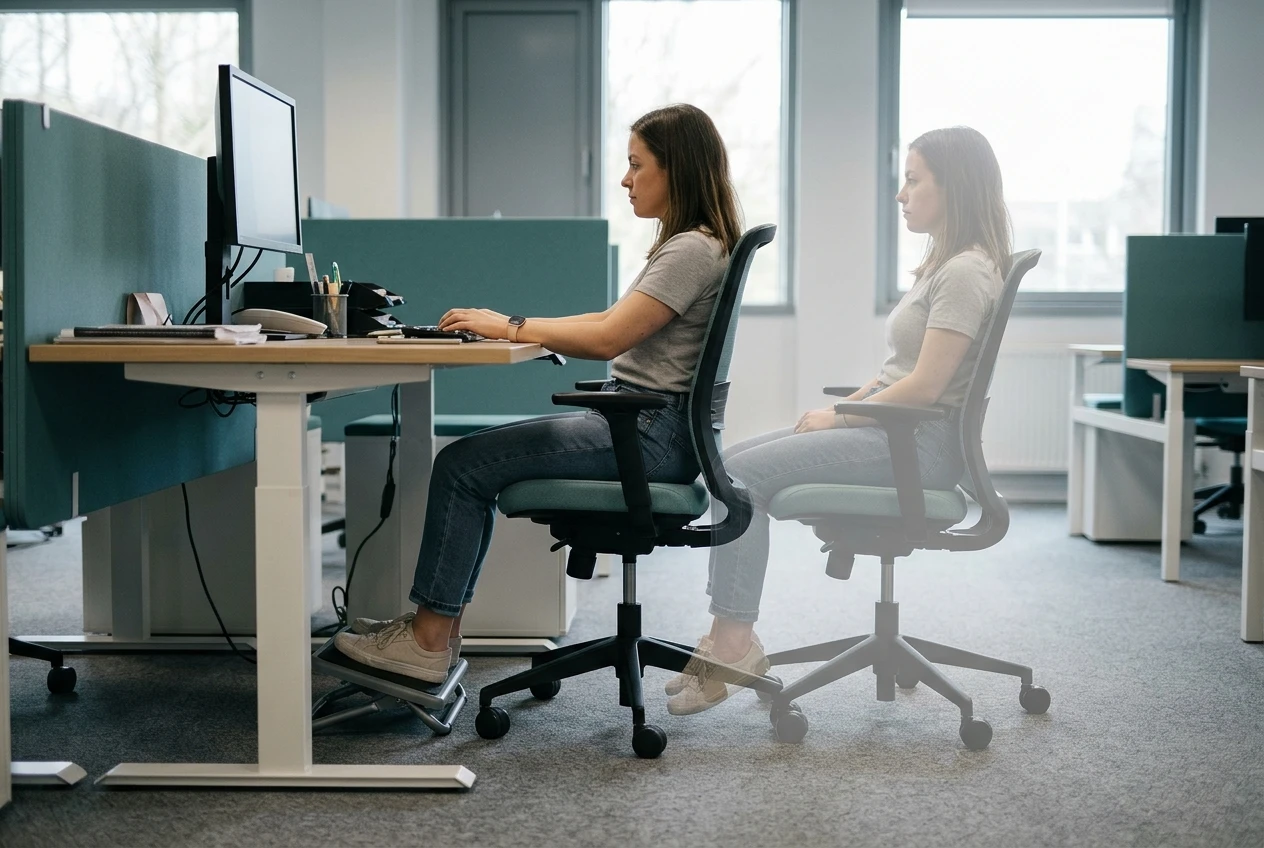
A footrest fills the gap. With your feet resting flat on it, your thighs can sit level or slightly angled, your hips stay back in the seat, and your back reaches the backrest. The footrest does the job the floor would do if the desk were lower.
Three groups tend to get the most from this:
- People who sit with the desk raised and cannot lower it without losing elbow height.
- People who stand for long stretches and want a way to vary their stance.
- Shorter users whose feet do not reach the floor when the chair is at the right height for the desk.
Rocking, tilting or flat: matching footrest type to how you work
Footrests come in three broad types, and the right one depends on whether you are standing, sitting, or alternating.
Flat or fixed footrests give a stable, unmoving surface. They suit seated work, where you need your feet supported and still. For standing, a low flat one works as a place to alternate one foot up at a time.
Tilting or angled footrests let your ankles change angle. Some have a fixed slope and some pivot. They suit people who like small ankle movements while seated and anyone who finds a flat surface uncomfortable at the ankle.
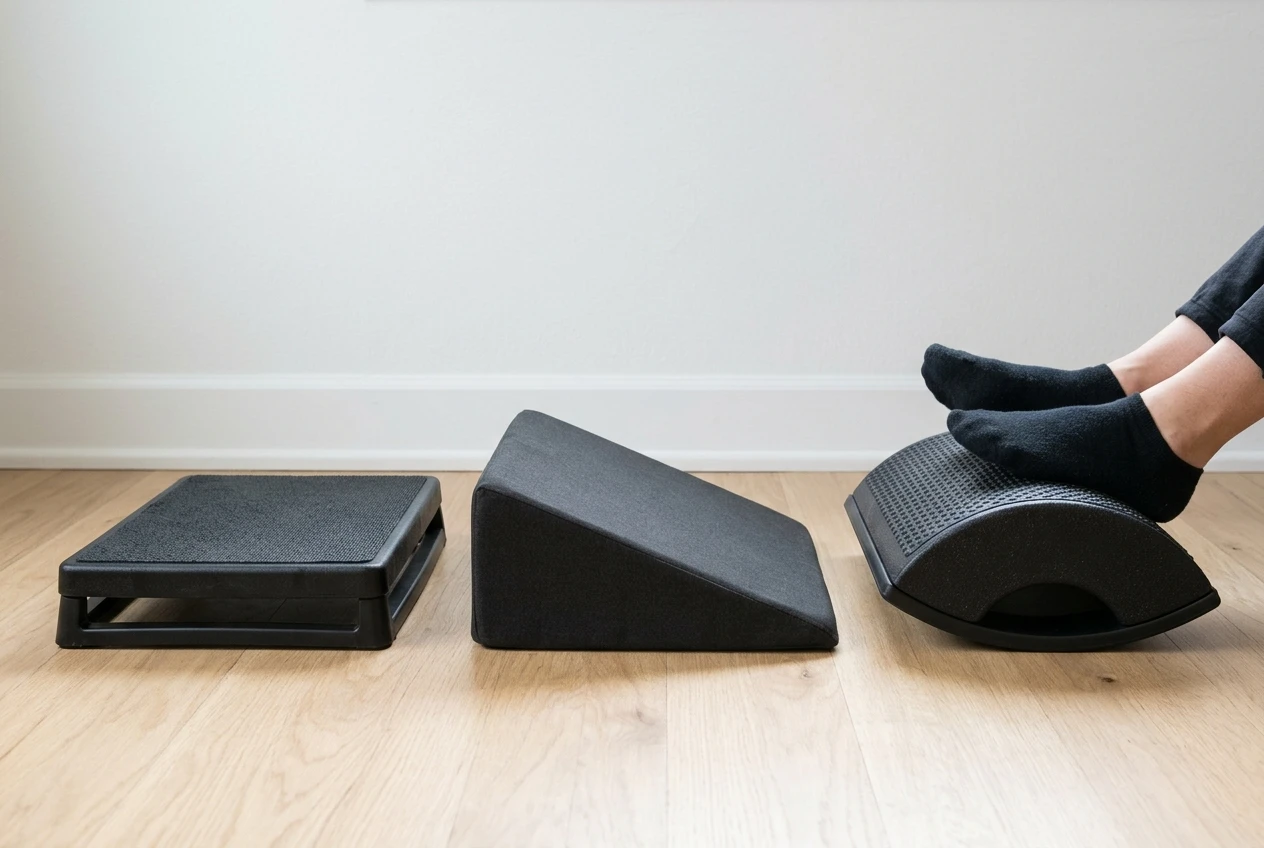
Rocking footrests move back and forth under your feet. They encourage the steady micro-movements that keep calves active, and they can be used sitting or standing. They also ask for more attention. If you do tasks that need precision from your lower body, such as using a foot pedal, or if you tend to feel unsteady, a rocking surface may be a distraction.
A practical way to choose: if your main problem is feet that do not reach the floor, pick flat or tilting. If your main problem is standing still for too long, a rocking one or a low platform for alternating feet gives you more variety. Many people do well with a footrest that has adjustable settings, so they can change type of movement across the day.
Height, angle and surface: what to check before you pick one
Check these specifications before buying, since a footrest that does not fit your body will go unused.
- Height range. For seated use, you want a rest that raises your feet enough that your thighs sit roughly level with your knees at or slightly below hip height. A fixed-height rest suits you only if its height happens to match your gap. An adjustable one covers more situations.
- Angle. Your ankles should rest in a comfortable, neutral position. If the angle forces your toes up or points them down, it will feel worse than no footrest.
- Surface size. It should be wide enough for both feet side by side and deep enough for your whole foot, not just the toes or heels.
- Surface texture. A textured top grips shoes or socks, and a smooth top lets the feet slide. Think about whether you work in shoes, socks, or barefoot, and look for a surface that suits that.
- Base stability. A footrest that slides on the floor or wobbles when you push on it is a nuisance. Look for a non-slip base, and check it against your floor type, since carpet and hard flooring behave differently.
If you cannot test a footrest in person, read the listed dimensions carefully and compare them to your own measurements before ordering.
Setting it up so it fits with your chair and desk height
Set up your desk and chair first, then the footrest. Adjust the chair so your forearms are level with the keyboard when the desk is at your working height. If you need a refresher on seat height, depth, and the other controls, the guide on how to adjust your ergonomic office chair, setting by setting walks through each one.
Once the chair is right, see where your feet land. If they rest flat on the floor with thighs supported, you may not need a footrest while seated. If they hang or your toes barely touch, place the footrest where your feet can rest on it without reaching forward.
For standing, keep the footrest just off to one side or under the desk, within easy reach of either foot. You want to be able to step up and step off without looking down or leaning. A footrest that is hard to reach will end up pushed aside.

Plan for both modes. When you switch from sitting to standing, you may need to slide the footrest out of the way, then bring it back later. Leave enough floor space for the chair to roll and for you to stand with both feet flat when you choose to.
Signs a footrest is not the fix and what to adjust instead
Sometimes foot and leg discomfort comes from somewhere else in the setup, and a footrest will not fix it. Consider these other causes first:
- Desk height is wrong. If your shoulders hike up or your wrists bend while standing, your feet and back will compensate. Set the desk so your elbows rest near a right angle.
- Monitor too low or too far. Leaning forward to read puts load on the lower back no matter what your feet are doing.
- Standing too long at once. Alternating between sitting and standing usually works better than extending either one. Change position before you feel tired.
- Chair seat too deep or too high. If this is the cause of pressure behind your knees, adjusting the chair will do more than adding a footrest. The post on an office chair that is adjusted but still hurts matches common symptoms to the setting that usually causes them.
- Footwear. Hard-soled or unsupportive shoes make long standing harder. A different pair, or going without shoes if your workspace allows, is a free test.
If you try a footrest and your discomfort stays the same or worsens after a couple of weeks of regular use, it is probably not what your setup is missing. Pain that persists, spreads, or comes with numbness or swelling is worth raising with a healthcare professional, not solving with accessories.
Check your setup against the head-to-toe checklist in your workstation audit to see whether your feet and legs are the real weak point.
That’s it for now peeps and have a great day!